What Works for One Tooth May Fail in Another: Choosing the Right Dental Crown Requires More Than Aesthetics
When patients are advised a dental crown, the question that usually follows is simple:
Which one is the best?
It’s a reasonable question. But clinically, it’s the wrong starting point.
Because in dentistry, there is no universally “best” crown. There is only the most appropriate option for a given situation.
The Misconception Around “Best”
Materials like Zirconia, EMAX, and Metal Ceramic are often presented in a hierarchy as if one clearly outperforms the others.
In reality, each of these materials is designed for a different purpose.
A crown that performs exceptionally well in one case may become a point of failure in another.
Not because the material is flawed but because the indication is different.
Dentistry Is Not Tooth-by-Tooth. It’s System-Based.
Teeth do not function in isolation.
Every restoration exists within a dynamic system that includes:
- Bite forces
- Jaw movement
- Muscle activity
- Opposing teeth
A crown placed without considering this system may look acceptable initially but fail under long-term functional stress.
This is why material selection cannot be generalized.
Understanding Where Each Material Fits
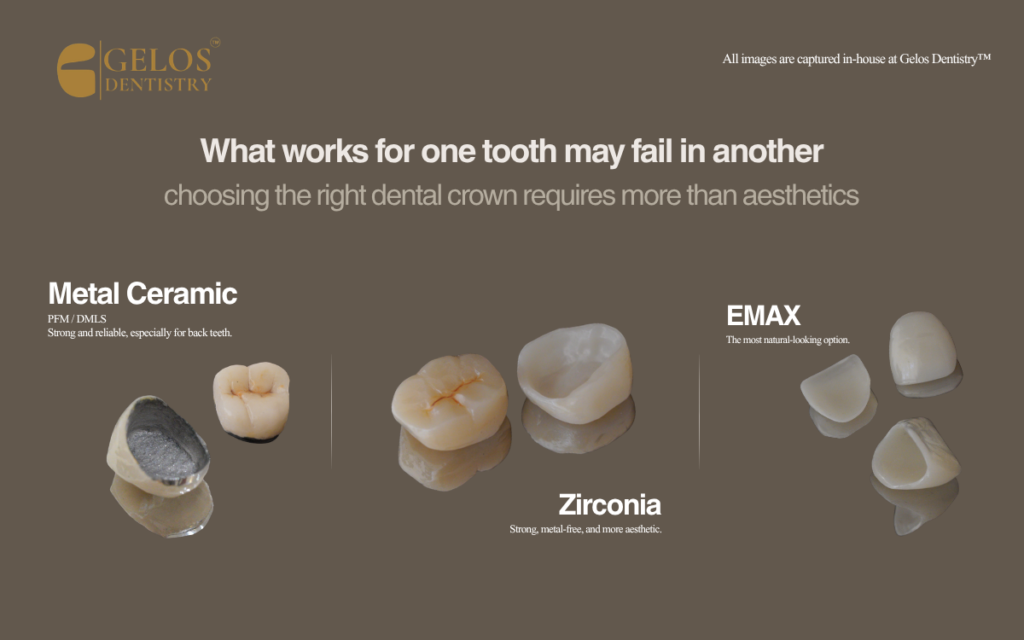
Metal Ceramic (PFM / DMLS)
A time-tested option known for strength and reliability. Particularly effective in posterior regions where chewing forces are high.
While it may not offer the same level of aesthetics as newer materials, it often delivers predictable long-term performance when used correctly.
Zirconia
A modern material that balances strength and aesthetics. Metal-free, durable, and versatile across multiple clinical situations.
It performs well in both posterior and selected anterior cases where durability is as important as appearance.
EMAX (Lithium Disilicate)
Chosen primarily for its aesthetic qualities. Its translucency allows it to closely mimic natural enamel.
Ideal for front teeth and smile design cases, but best suited for areas where bite forces are moderate.
Where Decisions Often Go Wrong
Many treatment choices are influenced by:
- Perceived “advancement” of materials
- Cost considerations
- Generalized recommendations
However, a material chosen for the wrong indication remains the wrong choice regardless of how advanced it is.
A More Structured Approach
At Gelos Dentistry, crown selection is guided by a combination of:
- Tooth position
- Functional load
- Bite dynamics
- Patient-specific expectations
This is supported by in-house 3D scanning and CBCT diagnostics, allowing for a more precise evaluation of structure and alignment.
The Real Question to Ask
If you’ve been advised a crown, the most important question is not:
“Which is the best?”
It is:
“Which is the most appropriate for this specific tooth and why?”
Because that answer reflects not just the material being used, but the clinical judgment behind the decision.
Final Thought
A successful crown is not defined by how it looks on day one.
It is defined by how well it performs over time within the system it is placed into.
And that begins with choosing correctly.
Gelos Dentistry Clinical decisions driven by precision, not assumption.