
Semi-Fixed Dentures: A Complete Patient Guide to Implant-Retained Dentures
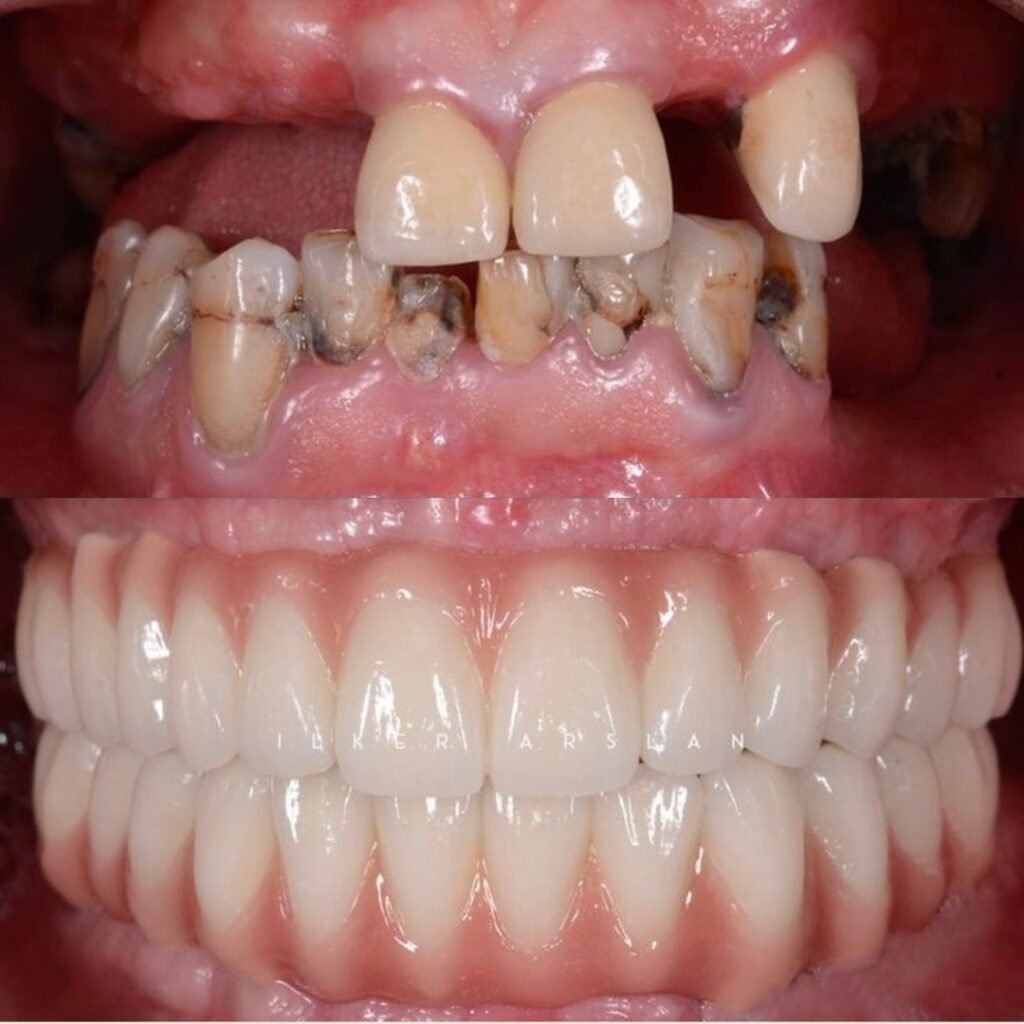
A secure, natural-looking alternative to loose dentures — and a treatment option worth knowing about if you have lost several or all of your teeth.
Losing teeth can affect much more than your smile. Many people notice that conventional dentures move while eating, feel loose when speaking, or require repeated use of denture adhesive. Others are concerned about the effect of extensive tooth loss on facial support, chewing and confidence.
This is where semi-fixed dentures, more accurately called implant-retained or implant-supported overdentures, can offer an interesting alternative.
They combine the convenience of a removable denture with the stability provided by dental implants.
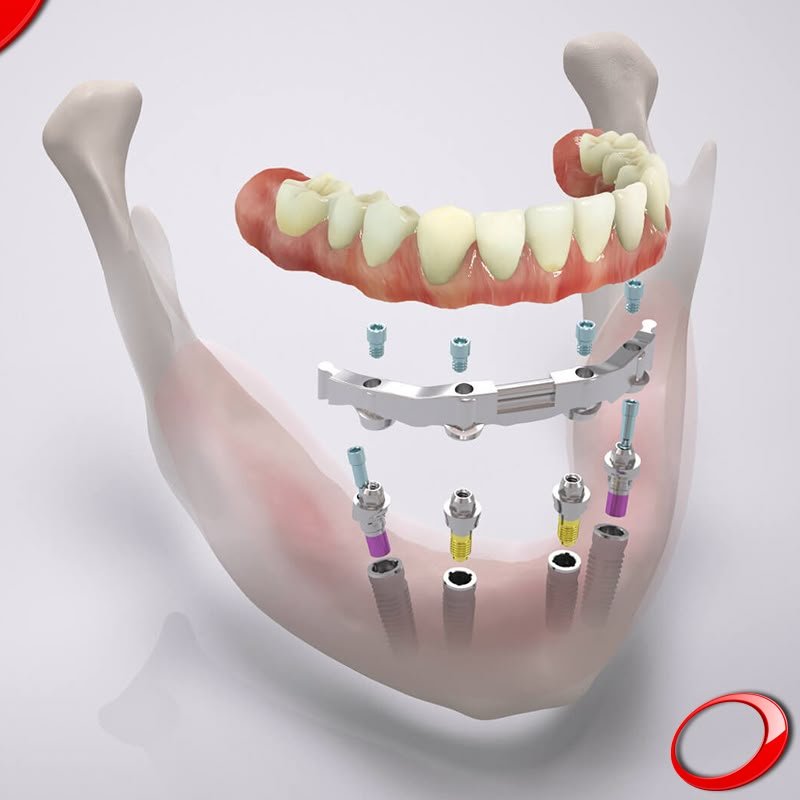
Instead of relying entirely on the gums and suction to keep the denture in place, specially designed dental implants are placed in the jaw and connected to the denture through precision attachment systems.
The result is a prosthesis that does not simply sit on the gums — it is securely retained by implants.
What exactly is a semi-fixed denture?
The term “semi-fixed denture” is commonly used to describe a denture that is removable by the patient but firmly retained by dental implants.
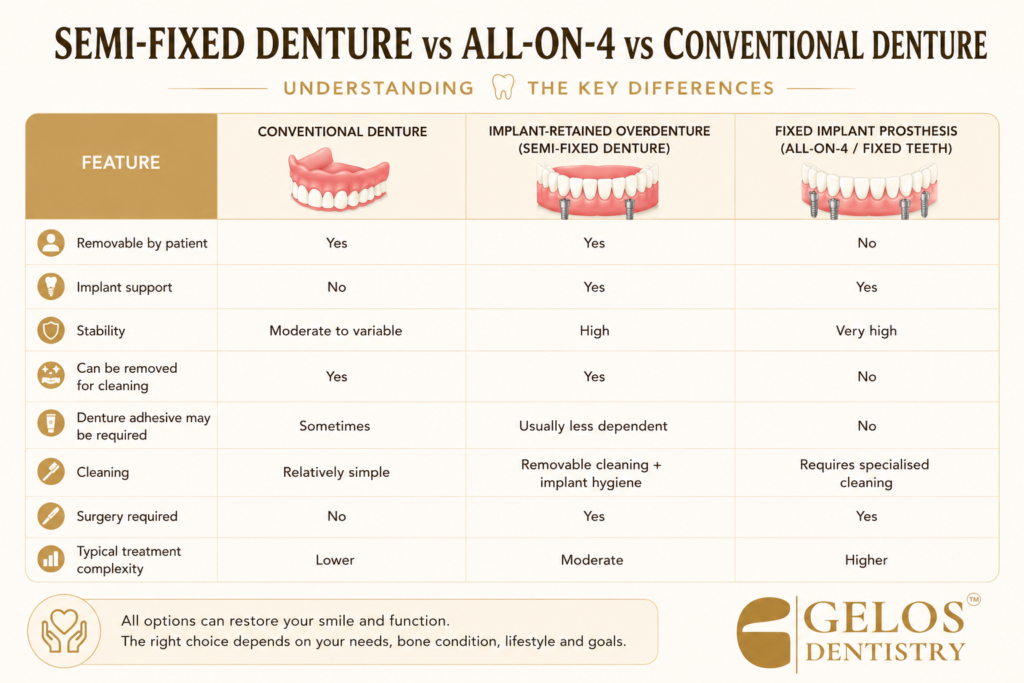
Think of it as a middle ground between two traditional options:
Conventional removable denture
The denture rests primarily on the gums and underlying tissues. It can move during chewing or speaking, particularly when the jaw has undergone significant bone resorption.
Fixed implant teeth
The replacement teeth are attached to dental implants and cannot be removed by the patient. They remain in the mouth and require meticulous cleaning around and underneath the restoration.
Implant-retained overdenture / semi-fixed denture
The denture attaches to dental implants using specialised connectors or attachments. It remains securely in position during normal activities but can be removed by the patient for cleaning.
The American College of Prosthodontists specifically describes implant-supported removable dentures as prostheses that can “snap on” to dental implants, while fixed implant restorations are removed only by the dental professional.
So, despite the name semi-fixed, the important distinction is this:
The implants are fixed. The denture is removable.
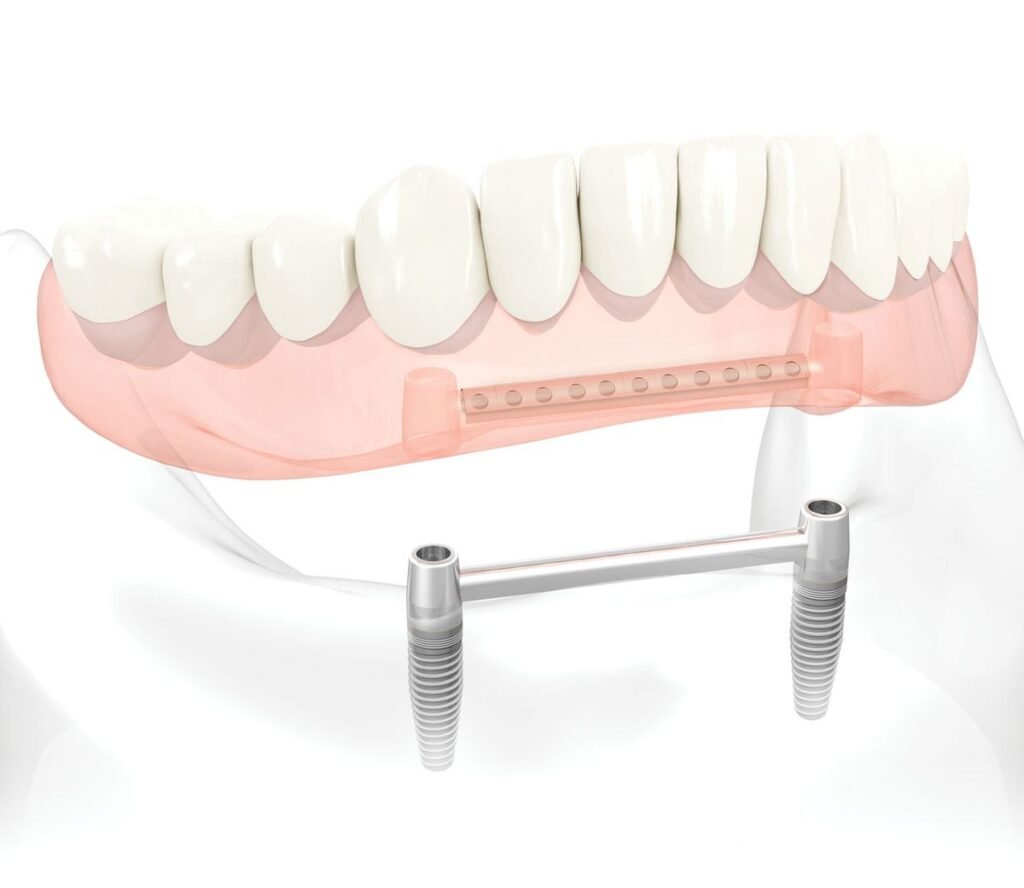
How does a semi-fixed denture work?
The treatment generally involves three components:
1. Dental implants
Small titanium implants are placed into carefully planned positions within the jawbone.
These implants function similarly to artificial tooth roots. They provide the foundation on which the denture can be retained.
The number of implants required depends on whether the restoration is being planned for the upper or lower jaw, the amount and quality of available bone, the shape of the arch, the planned prosthetic design and several other clinical factors.
Dental implants can be used to support individual crowns, bridges and removable dentures.
2. Precision attachment system
The implants are connected to the denture through an attachment system.
Depending on the clinical situation, this may include:
- Locator-type attachments
- Ball or stud attachments
- Bar-and-clip systems
- Telescopic or conus attachments
- Other precision attachment systems
These systems are not interchangeable in every patient.
The ideal attachment depends on factors such as implant position, implant angulation, available restorative space, bone conditions, desired retention, hygiene requirements and the design of the final prosthesis.
Research comparing different attachment systems has found that there is no single attachment that is universally best for every patient. Some systems provide greater retention, while others may offer advantages in limited space, hygiene or patient satisfaction.
3. The removable denture
The final denture contains the artificial teeth and gum-coloured portion of the restoration.
When you place it in your mouth, the attachment components engage with the implants.
You will usually feel a definite “click” or resistance as the denture seats into position.
Once properly seated, the denture is considerably more stable than a conventional denture.
Why do people choose semi-fixed dentures?
One of the biggest complaints associated with conventional dentures is movement.
A conventional denture depends substantially on the shape of the gums, jawbone, muscles, saliva and denture design for its stability.
As the jawbone naturally changes following tooth loss, the fit of a conventional denture can also change over time.
Implants provide an additional source of retention and stability.
Research has consistently shown that implant-supported overdentures can improve retention and stability compared with conventional complete dentures, and they can be particularly useful for patients who struggle to adapt to conventional dentures.
For many patients, the practical benefits can include:
Better stability while eating
The denture is less likely to shift or lift when chewing.
Greater confidence while speaking
Patients often worry about a denture moving when they speak, laugh or open their mouth.
Implant retention can substantially reduce this movement.
Reduced dependence on denture adhesive
Because retention comes from the implant attachments, many patients require considerably less reliance on denture adhesives.
Easier cleaning
Because the prosthesis is removable, it can be taken out for thorough cleaning.
This is one of the important advantages of a removable implant overdenture compared with a fixed full-arch implant restoration, which requires specialised cleaning around and underneath the prosthesis.
Improved chewing comfort
Greater stability can make eating more comfortable and predictable than with a loose conventional denture.
Improved confidence
For many patients, the biggest benefit is not simply chewing ability — it is the confidence of knowing that their teeth are unlikely to move unexpectedly.
Who may benefit from a semi-fixed denture?
An implant-retained overdenture may be considered when a patient:
- Has lost most or all teeth in an arch
- Finds a conventional denture loose or uncomfortable
- Has difficulty chewing with a conventional denture
- Experiences repeated denture movement while speaking
- Has sufficient bone for implant placement, or is suitable for appropriate preparatory treatment
- Wants improved denture stability
- Wants an implant-based solution but prefers a removable prosthesis
- Has anatomical or aesthetic considerations that make a removable overdenture particularly suitable
- Wants easier access for cleaning than a fixed full-arch restoration may provide
However, being without teeth does not automatically mean that implants are the right solution.
A detailed assessment is essential before deciding on the treatment.
The American College of Prosthodontists emphasises that implant treatment should be based on individual patient needs and careful diagnosis and treatment planning.
What if I have very little bone?
This is one of the most common concerns patients have.
When teeth are lost, the bone that previously supported those teeth gradually undergoes changes. The amount of available bone can therefore vary significantly between patients.
Importantly, having reduced bone does not automatically mean that implant treatment is impossible.
Depending on the individual situation, treatment may involve:
- Careful selection of implant positions
- Different implant dimensions or designs
- Bone augmentation procedures
- Sinus-related procedures in selected upper-jaw cases
- Alternative implant positioning
- A different prosthetic design
This is why a proper diagnostic assessment is more important than simply counting the number of implants.
At Gelos Dentistry, treatment planning can include 3D CBCT imaging and digital assessment to evaluate the available anatomy before implant placement.
The objective is not simply to place implants.
The objective is to determine where implants should be placed to create the most predictable final teeth.
How many implants are needed?
There is no universal number.
The answer depends on:
- Upper or lower jaw
- Bone quantity and quality
- Implant position
- Arch shape
- Implant angulation
- Available restorative space
- Type of attachment
- Desired level of stability
- Design of the final prosthesis
- Patient-specific anatomical and functional factors
For example, a two-implant mandibular overdenture is a well-established treatment option in appropriately selected patients. More implants may be recommended when greater support, stability or a different prosthetic design is required.
The older literature and newer systematic reviews both demonstrate that implant overdenture outcomes depend on the complete treatment design rather than simply the number of implants.
What are the different attachment systems?
Patients often hear terms such as Locator, ball, bar or telescopic attachments during their consultation.
These are simply different ways of connecting the denture to the implants.
Locator or low-profile attachments
These are compact attachment systems commonly used for implant-retained overdentures.
They can be particularly useful when restorative space is limited, and different retention inserts can provide different levels of retention.
Ball attachments
These use a ball-shaped component attached to the implant that engages with a corresponding component within the denture.
They are relatively straightforward and can work well when implants are suitably positioned and sufficiently parallel.
Bar-and-clip attachments
A custom bar connects multiple implants, and clips within the denture engage with the bar.
Bars can provide excellent retention and splint implants together, but they generally require more restorative space and require careful cleaning underneath the bar.
Telescopic attachments
These use precisely fabricated components that fit over one another.
They can provide a highly controlled form of retention and may be useful in carefully selected cases.
Current evidence suggests that different attachment systems can perform well, with differences in retention, maintenance and patient satisfaction rather than one system being universally superior.
Which attachment is best for me?
This is one of the questions where an online article cannot give you the correct answer.
The best attachment is determined after examining your mouth and planning your final prosthesis.
For example, an attachment that works beautifully for one patient may be unsuitable for another because of:
- Implant angulation
- Limited vertical space
- Implant position
- Bone anatomy
- Arch shape
- Hygiene ability
- Strength and dexterity
- Desired retention
- Prosthetic design
Interestingly, systematic reviews have found that different attachment systems can have broadly comparable implant survival and biological outcomes, while some systems may have advantages for retention or prosthetic maintenance.
In other words:
The attachment should be selected for the patient — not the patient selected for the attachment.
What does the treatment process involve?
Although every case is different, treatment generally follows several stages.
Step 1: Comprehensive consultation
Your dentist evaluates:
- Remaining teeth
- Gums and periodontal health
- Jawbone
- Bite
- Facial support
- Smile and tooth display
- Existing dentures, if any
- Functional concerns
- Medical and dental history
- Your expectations
The goal is to understand not only what is missing, but what the final result needs to achieve.
Step 2: 3D diagnostic planning
CBCT imaging may be used to evaluate the three-dimensional anatomy of the jaw.
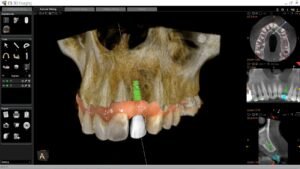
This can help assess:
- Bone height and width
- Important anatomical structures
- Implant positioning
- Available restorative space
- Relationship between the proposed implants and the final teeth
Digital scans and photographs may also be incorporated into comprehensive treatment planning.
Step 3: Implant placement
The implants are surgically placed in predetermined positions.
Depending on the case, additional procedures such as extraction, bone augmentation or other preparatory treatment may be required.
Step 4: Healing and integration
The implants need time to biologically integrate with the surrounding bone.
The exact timeline varies considerably between patients and treatment protocols.
In selected cases, temporary teeth or an existing denture may be used during the healing period.
Step 5: Prosthetic fabrication
Once the implants and surrounding tissues are ready, the definitive prosthesis is fabricated.
This stage involves carefully establishing:
- Tooth position
- Tooth shape
- Colour
- Bite
- Lip support
- Facial aesthetics
- Speech
- Retention
- Comfort
This is why a successful implant denture is not simply about placing implants.
The prosthetic planning is equally important.
Step 6: Delivery and adjustment
The denture is fitted to the attachment system and carefully adjusted.
Minor adjustments are common during the initial adaptation period.
Your dentist will also show you how to insert, remove and clean the prosthesis correctly.
Will a semi-fixed denture feel like natural teeth?
It is important to have realistic expectations.
An implant-retained overdenture can be much more stable than a conventional removable denture, but it is still a removable prosthesis.
It will not provide exactly the same sensation as natural teeth.
Natural teeth have periodontal ligaments and sensory receptors that contribute to the way we perceive pressure and movement. An implant does not reproduce that natural periodontal ligament.
The goal is therefore not to promise “teeth that feel exactly like natural teeth.”
The goal is to provide stable, functional, comfortable and aesthetically pleasing replacement teeth appropriate to your anatomy and needs.
Can I sleep with a semi-fixed denture?
Your dentist will advise you based on your individual treatment.
Because the prosthesis is removable, it can generally be taken out for cleaning and for giving the oral tissues an opportunity to rest.
The important point is not to establish a universal rule for every patient.
Your implant system, prosthesis design, oral tissues and individual circumstances should determine the maintenance protocol.
How do I clean a semi-fixed denture?
One of the major advantages of a removable implant overdenture is that you can remove it for cleaning.
Your daily routine should generally include:
Clean the denture
Remove the prosthesis and clean all surfaces thoroughly using the method recommended by your dentist.
Clean around the implants
The areas around the implant attachments must be kept free from plaque and food accumulation.
Depending on your anatomy, this may involve:
- Interdental brushes
- Special implant cleaning brushes
- Water flossers
- Superfloss or other specialised aids
- Conventional toothbrushes
Clean underneath the prosthesis
Food and plaque can accumulate beneath an overdenture.
Removing the prosthesis allows you to clean areas that would otherwise be difficult to access.
Attend regular maintenance appointments
Implant restorations require maintenance.
The prosthesis, attachment components, implants and surrounding tissues all need periodic evaluation.
Clinical practice guidelines for implant-borne restorations emphasise the importance of professional recall, biological maintenance, mechanical maintenance and appropriate home care.
Do semi-fixed dentures require maintenance?
Yes.
This is something patients should understand before choosing implant treatment.
Implants themselves can be highly successful, but the prosthesis and attachment components can experience wear over time.
For example, depending on the system, you may eventually require:
- Replacement of attachment inserts
- Adjustment of retention
- Relining or modification of the denture
- Repair of a fractured acrylic component
- Replacement of worn teeth
- Professional implant cleaning
- Periodic assessment of the implants and surrounding gums
This does not necessarily mean something has gone wrong.
Many attachment systems contain intentionally replaceable components that are designed to be serviced over time.
Recent systematic evidence comparing implant overdenture attachment systems has shown that prosthetic complications and maintenance requirements can vary between attachment types, even though overall implant survival is generally high.
What are the disadvantages of semi-fixed dentures?
A balanced treatment discussion should include the limitations as well.
They are still removable
If you want teeth that never come out of your mouth, a fixed implant rehabilitation may be more appropriate.
Implant surgery is required
Unlike a conventional denture, implant-retained dentures involve surgical treatment.
They require good hygiene
Implants are not immune to gum disease.
Plaque accumulation around implants can contribute to inflammation and potentially compromise implant health.
Attachments can wear
Some attachment components are designed to be replaceable and may need periodic maintenance.
The denture can still fracture
Although implant retention makes the denture more stable, the prosthesis is still a mechanical structure and can be damaged by accidents, excessive forces or unfavourable loading.
Treatment is more expensive than a conventional denture
The cost includes implant surgery, prosthetic components, laboratory work and long-term maintenance.
Not everyone is an ideal candidate
Bone anatomy, oral hygiene, systemic factors, smoking, functional habits, financial considerations and the ability to maintain the prosthesis can all influence treatment suitability.
Semi-fixed denture vs fixed implant teeth: Which is better?
There is no universal winner.
The better question is:
Which option is better for you?
A fixed implant restoration may be attractive to someone who wants a non-removable solution and has the anatomy, hygiene ability and budget for that treatment.
An implant-retained overdenture may be preferable to someone who values:
- Removability
- Easier access for cleaning
- Greater lip and facial support from a denture flange
- A potentially less complex implant solution
- The ability for the dentist to remove and service the prosthesis
- A balance between stability and cost
In patients with substantial bone and soft-tissue loss, a removable overdenture can sometimes provide facial and lip support that would be difficult to reproduce with a fixed prosthesis without unnecessarily long or bulky teeth.
The original review you shared specifically highlights situations involving loss of lip support and increased interocclusal space where an overdenture may offer important aesthetic and phonetic advantages.
Are semi-fixed dentures cheaper than fixed implant teeth?
They can be, but not always.
An implant-retained overdenture may require fewer implants and a less extensive implant-supported framework than some fixed full-arch solutions.
However, treatment costs vary significantly according to:
- Number of implants
- Need for bone grafting
- Implant system
- Attachment system
- Denture material
- Laboratory workflow
- Digital planning
- Temporary prosthesis
- Final prosthesis
- Maintenance requirements
It is therefore better to compare the complete treatment plan, rather than comparing only the initial implant fee.
What if I already have dentures?
You may not necessarily need an entirely new denture immediately.
In selected situations, an existing denture can potentially be modified to work with newly placed implants, provided its condition, fit, aesthetics, tooth position and structural integrity are suitable.
However, an existing denture is not automatically suitable for conversion.
The American College of Prosthodontists specifically notes that existing dentures may sometimes be used with implants if the denture is otherwise in excellent condition, but this requires professional assessment.
What happens if an implant fails?
Although dental implants have high survival rates, no implant treatment carries a zero-risk guarantee.
Implant failure can be associated with factors such as:
- Infection or peri-implant disease
- Poor bone conditions
- Excessive loading
- Smoking
- Implant positioning
- Medical factors
- Inadequate maintenance
- Prosthetic or biomechanical complications
If an implant fails, the treatment does not necessarily end there.
Your dentist will need to determine why the implant failed, allow the area to heal where appropriate, and decide whether another implant or an alternative prosthetic design is possible.
This is another reason why long-term maintenance is part of implant dentistry rather than an optional extra.
How long can a semi-fixed denture last?
There is no single number that applies to every patient.
The implants, attachments and denture are different components, and they do not necessarily have the same lifespan.
The longevity of your restoration depends on:
- Implant health
- Oral hygiene
- Bite and chewing forces
- Bruxism or clenching
- Prosthesis design
- Quality of fabrication
- Material selection
- Maintenance
- Regular professional review
- Changes in the jaw and oral tissues over time
A well-planned implant overdenture can be a long-term treatment, but it should never be presented as a “fit it once and forget it” solution.
What should I ask my dentist before choosing a semi-fixed denture?
A good consultation should give you answers to questions such as:
1. Why are you recommending a semi-fixed denture for me?
2. How many implants do I actually need, and why?
3. Would a fixed implant rehabilitation be better for my situation?
4. What happens if I choose a conventional denture instead?
5. What attachment system are you recommending and why?
6. Do I have enough bone for the planned implant positions?
7. Will I need bone grafting or any other preparatory procedure?
8. How will my lip and facial support be restored?
9. How will I clean around the implants?
10. What maintenance will the denture and attachments require?
11. What happens if an attachment wears or breaks?
12. What is included in the total treatment cost?
13. What are the alternatives if I decide against implants?
A good implant consultation should be about choosing between treatment options, not simply being told which treatment to purchase.
Frequently Asked Questions
Q1. Is a semi-fixed denture permanently attached?
Ans. No. In the usual patient-friendly meaning of the term, the denture is removable by the patient but is retained by dental implants.
Q2. Can a semi-fixed denture come loose?
Ans. It is designed to resist normal movement, but no removable prosthesis is absolutely immovable.
If your denture suddenly becomes loose after previously being stable, the attachment components, denture fit or implants should be examined.
Q3. Will people know I am wearing a denture?
Ans. A well-designed prosthesis should be designed to look natural rather than obviously artificial.
Tooth shape, colour, gum contours, tooth position, lip support and facial proportions all influence the final appearance.
Q4. Can I eat normally with an implant-retained denture?
Ans. Most patients can eat substantially more comfortably and confidently than they could with a poorly fitting conventional denture. However, adaptation takes time and very hard or sticky foods may still require caution depending on the design.
Q5. Can I remove it myself?
Ans. Yes. One of the defining features of a removable implant overdenture is that the patient can remove it for cleaning.
Q6. Are implants better than dentures?
Ans. Not necessarily for everyone.
Implants are a treatment option, not a replacement for proper diagnosis.
Some patients are excellent candidates for implant treatment, while others may be better served by conventional dentures, tooth-supported prostheses or fixed implant restorations.
Q7. Is a semi-fixed denture the same as a removable denture?
Ans. Not exactly.
Both can be removed by the patient, but a semi-fixed/implant-retained denture receives additional retention from implants rather than relying primarily on the gums.
Q8. Can I get a semi-fixed denture if I have diabetes or other medical conditions?
Ans. Medical conditions do not automatically rule out implant treatment, but they may influence healing, surgical risk and treatment planning.
Your dentist should review your medical history and coordinate care when necessary.
Q9. Is a semi-fixed denture suitable for everyone?
Ans. No.
The decision should be based on your anatomy, oral health, bone availability, functional needs, expectations, hygiene ability and overall treatment goals.
The most important thing to understand
A semi-fixed denture is not simply a better version of a conventional denture.
It is a different prosthetic concept.
It combines:
Dental implants + precision attachments + a removable prosthesis + careful prosthetic planning + long-term maintenance.
When these components are planned together, implant-retained overdentures can provide a highly stable and functional solution for appropriately selected patients.
But the best treatment is not necessarily the one with the most implants or the most expensive prosthesis.
The best treatment is the one that matches your anatomy, your oral health, your functional needs, your expectations and your long-term ability to maintain it.
Considering semi-fixed dentures?
If your dentures feel loose, uncomfortable or unstable — or if you are exploring options after losing multiple teeth — a comprehensive implant and prosthodontic assessment can help you understand what is realistically possible.
At Gelos Dentistry, treatment planning can combine clinical examination, detailed photographic records, digital scans and 3D CBCT assessment to evaluate the relationship between your existing anatomy and your proposed final teeth.
The aim is to plan the final smile and function first, and then determine the implant and prosthetic design needed to support it.
Book a consultation at Gelos Dentistry to discuss whether an implant-retained or semi-fixed denture is appropriate for you.
Scientific references and further reading
- Martínez-Lage-Azorín JF, Segura-Andrés G, Faus-López J, Agustín-Panadero R. Rehabilitation with implant-supported overdentures in total edentulous patients: a review. Journal of Clinical and Experimental Dentistry. 2013;5(5)–e272.
- Attachment systems for mandibular implant-supported overdentures: A systematic review and meta-analysis of randomized controlled trials. Journal of Prosthetic Dentistry. 2024;132(2):354–368. This review included 25 randomized controlled trials involving 2,154 implants and 737 overdentures and found high implant and prosthesis survival across attachment systems, with differences in prosthetic complications and maintenance.
- Mandibular implant-supported overdenture: A systematic review and meta-analysis for optimum selection of attachment system. Journal of Indian Prosthodontic Society. The review found differences between attachment systems in retention, patient satisfaction and peri-implant outcomes, reinforcing the importance of individualised attachment selection.
- Splinted and unsplinted overdenture attachment systems: A systematic review and meta-analysis. Journal of Prosthetic Dentistry. Evidence showed broadly similar marginal bone loss, prosthetic complications and implant survival between splinted and unsplinted systems.
- American College of Prosthodontists. Frequently Asked Questions about Dental Implants.
- American College of Prosthodontists. Position Statement: Dental Implants.
- American College of Prosthodontists. Clinical Practice Guidelines for Recall and Maintenance of Patients with Tooth-Borne and Implant-Borne Dental Restorations.
This article is intended for patient education and does not replace an individual clinical examination, radiographic assessment or treatment consultation.